Click here to download the full paper (PDF)
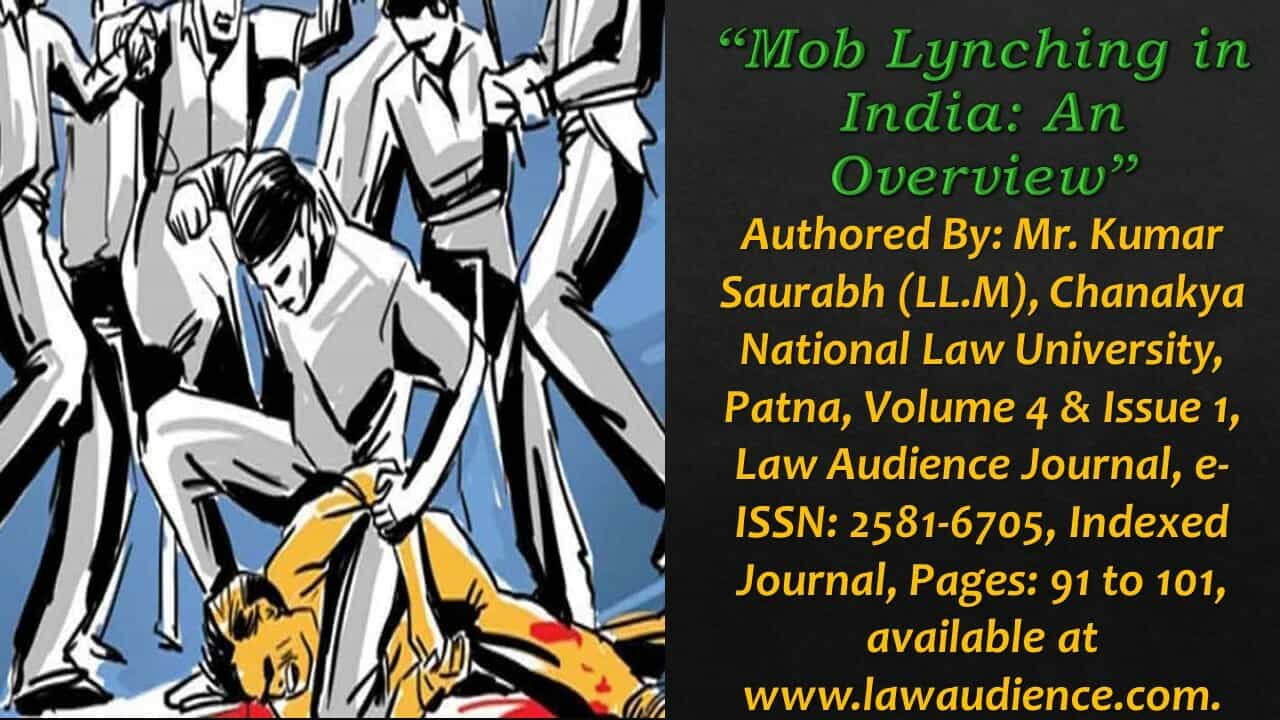
Authored By: Mr. Kumar Saurabh (LL.M), Chanakya National Law University, Patna,
Click here for Copyright Policy.
INTRODUCTION:
“It’s not clear where the word “lynch” came from, but it probably came from the American Revolution. The word “lynch” comes from the phrase “law of the lynch mob,” which means punishment without a trial. Most people agree that the phrase was made up by Charles Lynch and William Lynch, two Americans who lived during this time. Lynching is a form of unjust execution by hanging that is done by a mob that is not working with the local police or law enforcement. But now, it’s a broader term that can be used to describe an act or a series of acts by a group of people who form an illegal assembly, take the law into their own hands, and commit crimes against a person or a group of people in order to punish them themselves. In India, lynching is a sign of the tensions between different ethnic groups. Communities sometimes kill people who have been accused or who seem suspicious. Since 2014, there have been a lot of lynching in India because of cow vigilante violence. Mostly, Hindu mobs have killed Indian Muslims and Dalits.
Indians also had to deal with Indian WhatsApp lynching, which is a wave of violence and killings caused by the Mob after rumours, mostly about kidnapping and organ harvesting, spread through the WhatsApp message service. India has a long history of mob violence, vigilant justice, and mass panics, but these things have usually happened in small areas. What makes the Indian WhatsApp lynching of 2017-2018 different is that violent acts have been filmed and shared across the country through social media. This has created and kept alive an atmosphere of fear and false information that has led to more violence in places that have nothing to do with each other. For example, violent lynching in Maharashtra has been linked to a video of a lynching that happened in Karnataka”.
I. WHAT IS MOB LYNCHING:
The Oxford English dictionary refers to lynching as “the act of killing done by a mob without any legal authority or process involved.” The term ‘mob lynching’ is used to describe the acts of targeted violence by a massive group of people. The violence is tantamount to the offences against the human body or property (both public as well as private). The crime is committed by the mob believing that they are punishing the victim for doing something wrong; hence they take the law in their own hands to punish the purported accused without acting in accordance with the rules of law. As aptly referred to by the hon’ble supreme court as a ‘horrendous act of mobocracy’ mob lynching have a pattern as well as a motive. More often than not, innocent people are targeted based on some rumour, misinformation or suspicion.[1]
In Cardamom Marketing Corporation and Ors. vs. State of Kerala and Ors.,[2] Justice Dr A.K. Sikri, observed that:
“When we talk of sound and stable system of administration of justice, all the stakeholders in the said legal system need to be taken care of….it is wisely said that for any society governed by rule of law, an effective judicial system is a necessary concomitant. The rule of law reflects a man’s sense of order and justice. There can be no government without order; there can be no order without law….”[3]
II. HISTORICAL BACKGROUND:
During the American Revolution in the middle of the 18th century, people in the United States came up with the word “lynch.” It was put in the form of “lynch law,” which means punishment without a trial. Historians say that planter Charles Lynch and his son William Lynch were the first to use the word to talk about the extra-judicial power that people like him had. Over time, it came to mean killings by crowds that didn’t follow the law. This happened most often to African-Americans in the late 1800s. During that time, lynching was mostly done to black people, and there were even reports of a few cases in the US before the Civil War. In some cases, white people who supported slavery against black people were also lynched. In many countries, vigilante justice was used when unofficially organized groups tried to help with the legal justice system. For example, lynching was one of the punishments in Germany’s fehmic courts.[4] There were two major plans to lynch people in the community and in the past;
- The classic lynching is when a member of a group punishes a newcomer or someone from outside the group. It can be connected to one bad thing that was done.
- The communal lynching: People in the group punish a member of the group. It happens when the same person breaks the law several times over a period of time.[5]
The first case of lynching was witnessed in St. Louis in 1835, McIntosh black man killed a sheriff while he was taken to jail. He was chained to a tree and pushed to death in front of 1000 people. Lynching, which was first started in America became a focal point of many other countries as well. Many countries the cases of lynching generally occurred due to racism.[6] Mob lynching is not new in India although the word is of foreign origin. For the first time Indian legal history in the national campaign against mob lynching draft for “protection from lynching act, 2017 defined term “lynching”, “mob”, and “victims of mob lynching”.
It still exists in India due to set up of its historical background and reasons why it grew are as follows:[7]
- Structure of society which is still recognised in our society on the basis of religions and castes. Community identity is one of the drivers that leads to violence of lynching.
- The weakness of the government and judicial system to challenge the mob.
India is observing a high rise in cases of mob lynching as well. Taking the law into hands could be dangerous. There is no particular reason for the existence of mob lynching. However, event leads to heinous crime when a victim has committed a particular crime that has hurt the moral sentiments. Mostly in India, victims of lynching are minorities Dalits or Muslims, lynching against cow smuggling allegations, and lynching related to child-lynching suspicion.[8] This offence is a threat to our nation and modern society because the mob takes into hand the role of the state. If it is allowed, it will lead to Hobbes’ state of nature which claims man to be nasty and society remains in a state of non-peace.[9] Few incidents that happened in the history of India portrayed the same.[10] In 2018 Supreme Court described lynching as a “horrendous act of mobocracy”. In case “Tahseen S. Poonawalla vs. Union of India and Others”, issued guidelines for the police administration of the entire country as an interim order. Further Supreme Court issued guidelines out of which main steps are as follow:[11]
- It was ordered to designate an officer of SP rank as nodal officer to prevent mob violence;
- Broadcasting of messages that involvement into lynching shall invite severe consequences by the Centre, state and local authorities;
- Spreading of fake news and messages shall lead to the filing of FIR against culprit;
- Failure on the part of police and district administration on complying with SC’s guidelines will amount to negligence;
- States to make compensation schemes for victims;
- Lynching cases should be tried out by fast-track courts in each district and to be concluded in 6 months.
III. FAMOUS LYNCHING INCIDENTS IN INDIA:
III.I KHAIRLANJI LYNCHING:
Khairlanjimassare (or kherlanji massacre) is one of the first cases of lynching which held in September 2006 when four individuals were lynched over a land dispute. A village named kherlanji in bhandara district of Maharashtra where a mob of minimum fifty villagers of politically dominant kunbi caste stormed into the Bhotmange’s house and lynched four members of the same family. Bhotmange’s wife and daughter were paraded naked in the whole village, and the ladies were sexually assaulted before slaughtering them.[12]
III.II 2009 MANGALORE PUB ATTACK:
Sri Ram Sena, a radical group, consisting of forty activists attacked young men and women in a pub named, “amnesia-the lounge” in Mangalore, Karnataka on 24th January 2009 stating that these young women are violating the traditional Indian values. The founder of this group, when interviewed by one of the esteemed newspapers, was unapologetic on this incident and answered that why should girls go to pubs, drink alcohol and wear westernized clothes. Later, a few years back in 2018, the activists were acquitted due to lack of evidence.[13]
III.III DADRI MOB LYNCHING:
This incident happened in a village, Bisara near Dadri in Uttar Pradesh on 28th September 2015. A mob of villagers attacked the house of 52-year-old Mohammed Akhlaq after one of his neighbors accused him of stealing and slaughtering his missing calf. The local villagers carrying sticks, bricks and knives attacked Akhlaq’s house at night and accused his family of consuming beef and storing the cow meat in the refrigerator. The mob dragged and attacked Akhlaq’s and his son even after repeated denial of the fact by the family. It was considered as one of the first mob lynching incidents in the name of cow and beef.[14]
III.IV ALWAR LYNCHING:
Pehlu Khan, a 55-year-old who was a dairy farmer from Nuh district in Haryana. On 1st April when he was transporting cows for his dairy farm and was beaten up mercilessly by a group of 200 cow vigilantes. He was accused of smuggling cattle, but instead, he bought a cow for milking with a receipt. Police could not arrest the ones that were named in the dying declaration of Khan, but the Police managed to arrest the vigilantes after a video of the incident went viral.[15]
III.V THE JHARKHAND LYNCHING, 2019:
This incident was brought under light after a video of the incident went viral and resulted in public anger. A mob attacked a 24-year-old Tabrez Ansari in Jharkhand on 17th June 2019. He was brutally thrashed and beaten on suspicion of bike theft. He was tied to the tree and Ansari; a Muslim was forced to chant Hindu sayings. Ansari was arrested and was kept in prison and when one of the relatives went to see him only to find him severely injured. The relative’s request to the medical officer of the prison was also denied, and later, he was taken to the hospital when his condition became severe. He died several days later.[16]
III.VI PALGHAR MOB LYNCHING:
The recent case of mob lynching where a vigilante group on 16th April 2020 lynched two Hindu Sadhus and their driver. The incident of Gadchinchale Village in the Palghar district of Maharashtra was fueled by rumors which were circulated on WhatsApp regarding thieves operating in the area during coronavirus lockdown. The vigilante group had mistaken the two sadhus and the driver as thieves and killed them. They even injured the policemen who intervened their action.[17]
IV. REASONS FOR MOB LYNCHING IN INDIA:
IV.I COW VIGILANTE RELIGIOUS VENDETTA:
The sale of cow meat has always been a point of conflict in society. It has mostly resulted in a mob attack. After prohibiting of sale of cow meat under the Prevention of Cruelty to Animals Act in 2017, there has been a rise in cow vigilante. In the first six months of 2017, 20 cow-terror attacks were reported–more than 75% of the 2016 figure, which was the worst year for such violence since 2010.[18] A Muslim man in Jharkhand was accused of stealing a bike from the hospital and was thrashed by a mob. He was forced to chant ‘Jai Sri Ram’ and ‘Jai Hanuman’ while being tied on a pole by a group of angry mobs[19].
Some of the cases are:
- Dadri Lynching: it occurred in the year 2015 in Bisara village, Uttar Pradesh. Mohammed Akhlaq and his son Danish was accused of slaughtering and theft of cow-calf and storing its meat for consumption. When knowledge of this fact came into the observance of Hindus, then a Hindu mob lynched the father and the son for this fact. Fact- it is considered one of the first mob lynching cases, which was religious based in the name of cow and beef.
- Haryana Lynching in 2017, June: in Tughlagabagh, Haryana, 3 Muslim brothers were travelling on the train from Tughlagabagh to Ballabhgarb. The brothers were mob lynched by the members in the train because of suspicion of carrying beef along with them. Fact- one of the brothers died named Junaid, and the other brothers survived multiple stabs.
IV.II SUSPICION OF CHILD LIFTERS AND SOCIAL MEDIA RUMOURS:
The rumours or fear of child kidnappers has been a reason for mob attack. Thiruvannamalai in Tamil Nadu, Karbianglong in Assam, and Chittoor in Andhra Pradesh are heavily linked in more ways than one. These three districts witnessed murders by the mobs. The perpetrators were residents, and the trigger was a piece of information circulated in social media platforms. Social media plays a massive role in spreading of rumours like children being kidnapped from neighbouring villages for the purpose of illegal sale of organs.
- In vellore, tiruvannamalai and Tiruvallur districts of northern Tamil Nadu, WhatsApp posts were circulated about 200 criminals from “North India” entering the state to lure children away. This claimed three lives and incited numerous mob attacks. The first victim was a mentally deranged man in his thirties who was found roaming in Parasuramanpatti village in Gudiyatham in Vellore district. The “Hindi Speaking” man was hacked to death on 28th April.
- In a more chilling incident, a 45-year-old homeless beggar was beaten to death and hung from a bridge in Pullicat. All three incidents happened within a span of two weeks[20].
- A 40-year-old woman was beaten to death by a mob of around 30 people in Ahmedabad on suspicion of being a child-lifter. In another incident, a 45-year-old woman was assaulted in Surat or the same reason. The woman was attending a family function. She had stepped out to buy balloons for her three-year-old daughter when she was assaulted by a mob which pulled her child away from her. Following the Ahmedabad lynching, Gujarat Police issued an advisory warning people against taking law in their hands and asking them not to believe social media rumors about child-lifting gangs[21].
IV.II.I ROLE OF SOCIAL MEDIA:
It is a known fact that internet usage in India is increasing day by day. Social media engagement is very high. If we consider the current situation, social media has been a savior in the time of this pandemic in terms of entertainment. In traditional times, the only way of disseminating information was word of mouth, which of course has a very less reach. However, at present times, social media has taken over, and information spreads like a wildfire. ‘WhatsApp’ is one of the social media players, helps in connecting people all around the globe. With more than 200 million users, India is WhatsApp biggest market. It also has an ‘end to end encryption’ which gives users their privacy and their messages does not get shared to anyone else other than the parties involved in the conversation, so to track the origin of the fake rumor is next to impossible. Following the death of 22 people due to spreading of fake news, ministry of electronics and it had asked the officials of WhatsApp to curb the spread of fake news on its platform. WhatsApp retained its policy of end-to-end encryption but had limited the scope of forwarding messages. Earlier the message could have been forwarded to 256 people. Now message can only be forwarded to five people, and the message is marked as ‘forwarded’. WhatsApp has also introduced the feature where only admins can send message to a group, and participants are restricted to send messages in the group. WhatsApp has been involved in spreading digital literacy and means to avoid fake rumors. Moreover, a message which is labelled as ‘highly forwarded’ can only be forwarded to one person as opposed to five[22]. However, is it really effective? Even though the limitation has been set on forwarding a message, but the origin of the message is still not traceable. The sad truth is that people rely on the information shared on WhatsApp rather than relying on news channels. If this trend is followed, the fate of people will depend on the forwards, and the idea of ‘instant justice’ to the perpetrator will demolish the legal system of our country and democracy.
V. APPLICABLE LAWS FOR LYNCHING:
Sections 307 (attempt to commit murder), 323 (causing voluntary hurt), 325 (grievous hurt) 147 (rioting), 148 (rioting armed with deadly weapons) and 149 (unlawful assembly) of the IPC would apply in case of an act of mob lynching. The first clause under Section 149 is the existence of a common object between the members of an unlawful assembly, the second is the knowledge of the likelihood of commission of such an offence by the unlawful assembly which would make a person vicariously liable under. Section 302 (punishment for murder) read with Sections 34 (common intention) or Section 120 B (criminal conspiracy) of the IPC can be made applicable to charge the whole mob if such mob violence results in the death of the victim. Under Section 223 (a) of the Criminal Procedure Code, persons accused of the same offence as part of the same transaction may be prosecuted.
The Protection of Lynching Act, 2017 also known as the Manav Suraksha Bill (MASUKA) put forth by the National Campaign against Mob Lynching (NCAML), defined, for the first time in Indian legal history, the terms ‘lynching’, ‘mob’ and ‘victim’. Provision was made for Special Courts for the expeditious trial of such offences and for the rehabilitation of the victim and/ or their families. It made lynching a non-bailable offence, criminalised dereliction of duty by a policeman, criminalised incitement on social media, and stipulated that adequate compensation be paid, within a definite time frame, to victims and survivors. It also guaranteed a speedy trial and witness protection. The effect of this Bill, however, remains dormant until it is passed by the legislature.
State Legislations on Lynching:
Adhering to the directives of the Supreme Court, the State of Manipur passed an Ordinance to create a special offence of lynching so as to instil fear in the minds of people and to also rehabilitate the victims of such horrendous acts. The legislation in Manipur restricts hate crimes only to those that involve mobs. It also punishes public officials for dereliction of duty. Being the second state to pass a bill against mob lynching, The Rajasthan Protection from Lynching Bill-2019 aims at prevention and protection by appointing special judges for speedy trials of a victim’s family. The death of the victim would result in life imprisonment of the offender along with a fine of rupees five lakhs. This Bill was opposed by the BJP for ‘being brought just to appease one community’.
The Uttar Pradesh Law Commission submitted a 128-page report citing various cases of lynching in the state coupled with the recommendations made by the Supreme Court in 2018 on mob lynching, along with the draft Bill to Chief Minister Yogi Adityanath. The Uttar Pradesh Combating of Mob Lynching Bill, 2019 aims to ensure effective protection of the constitutional rights of vulnerable persons, to punish acts of mob lynching, to provide for designated courts for the expeditious trial of such offences, for the rehabilitation of victims of mob lynching and their families. It also suggested punishment for conspiracy, aid or abetment in such cases as well as for obstructing the legal process.
VI. CONCLUSION:
Mob lynching is gaining ground in a burgeoning democracy like India, which is home to diverse culture and traditions. This primarily shows that people have lost faith over the legislature, judiciary and the administration that they are willing to take law in their hands. The law is the mightiest, and no one has the right to punish anyone irrespective of any issues. By making this hate crime communal and playing the blame game will not result in any solutions but will result in emotional pain to the victims of the mob hate. The need of the hour is bringing a robust law on mob lynching, which will curb menace from society. Also, we need to work on the loopholes present in the system, right from filing an FIR to the investigation of the crime without delay and forgery and providing speedy justice to the victims, by keeping a check on the social media platforms where certain groups spread hate and manipulate the views of people. Placing the onus on social media posts and messages which are forwarded in the messaging site will only help unless we spread digital literacy among the citizens. To tackle fake news, the government should take the help of mass media like newspapers, radio and television. The state government should draft an anti-lynching law in accordance with the Supreme Court guidelines. On an individual basis, we should condemn such an act and should report any fake news that we come across by spreading awareness among our acquaintances.
At present, states are promulgating their own legislations to deal with the menace of mob lynching. However, each state is doing so at its own pace, leading to haphazard mechanisms of tackling such horrendous acts. Thus, having a uniform law govern ‘lynching’ which not only clearly defines what constitutes the act but also prescribes uniform procedure and punishment for the same is the need of the hour. Whether national legislation that prohibits and punishes mob lynching as opposed to an amendment in the IPC to that effect would be ideal is debatable as it must be discerned whether the effective implementation of the hitherto existing laws under the IPC are sufficient or if there is a need for new legislation or provision under the IPC to specifically deal with crimes pertaining to mob lynching. While the Supreme Court has issued directives for states to follow, it remains ineffective as current laws cannot keep up with the rise in cases of lynching. Hence, as argued above, we must strive to attain uniformity in laws, procedure and punishment for the inhumane act of mob lynching.
Cite this article as:
Mr. Kumar Saurabh, “Mob Lynching in India: An Overview”, Vol.4 & Issue 1, Law Audience Journal (e-ISSN: 2581-6705), Pages 91 to 101 (11th May 2022), available at https://lawaudience.com/mob-lynching-in-india-an-overview/.

Footnotes & References:
[1] Vageshwari Deshwal, A discretion of the ‘Rule of Law’, Times of India, https://timesofindia.indiatimes.com/blogs/legally-speaking/mob-lynching-a-desecration-of-the-rule-of-law/.
[2] MANU/SC/1268/2016.
[3] SEVENTH REPORT OF VII STATE LAW COMMISSION ON MOB LYNCHING, http://upslc.upsdc.gov.in/MediaGallery/7thReport.pdf.
[4] Geoffrey Abbott, Lynching Mob Violence, BRITANNICA, https://www.britannica.com/topic/lynching.
[5] Roberta Senechal de la Roche, why is Collective Violence Collective, 19 SOCIOLOGICAL THEORY 126, 130 (2001).
[6] Nitya Nand Pandey, Mob Lynching: A New Crime Emerging In Indian Society, 5 IJRAR 808, 809 (2018).
[7] Aakar Patel, The story of India and its lynch mobs, THE ASIAN AGE (July 1, 2018).
[8]Arnold HT Sangma, Mob lynching: An uprising offence needed to be strenuous under the Indian legal system, 2 INTERNATIONAL JOURNALOF ACADEMIC RESEARCH AND DEVELOPMENT 30, 30 (2017).
[9] Akanshit Jha & Aditya Agarwal, Mob-Lynching and Massacre, Threats to The Nation: Can “Masuka” Address the Issue? 4 ROSTRUM’S LAW REVIEW (2018).
[10]Crime in India 2018, NCRB, https://ncrb.gov.in/sites/default/files/Crime%20in%20India%202018%20-%20Volume%201.pdf.
[11] https://www.delhipolice.nic.in/SUPREME%20COURT%20GUIDELINES.pdf.
[12] Reader’s Editor, Khairlanji: the crime and punishment, The Hindu, https://www.thehindu.com/opinion/Readers-Editor/Khairlanji-the-crime-and-punishment/article16149798.ece.
[13] Anusha, Mangalore pub attack: Sri Rama Sena activists acquitted due to lack of evidence, One India.
[14] The Dadri Lynching: how events unfolded, The Hindu, https://www.thehindu.com/specials/in-depth/the-dadri-lynching-how-events-unfolded/article7719414.ece.
[15] Ashok Kumar, Alwar lynching: In Lalawandi village, cow protection is serious business, The Hindu, https://www.thehindu.com/news/national/alwar-lynching-in-lalawandi-village-cow-protection-is-serious-business/article24505343.ece.
[16] India Today Web Desk, Jharkhand: Muslim man beaten up on suspicion of theft, India Today( June 23, 2019), https://www.indiatoday.in/india/story/jharkhand-muslim-man-lynching-jai-shree-ram-jai-hanuman-1554634-2019-06-23.
[17] Zeeshan Shaikh, Palghar Lynching: A recap of what happened, The Hindu(April 24 2020, 7:10).
[18] Delna Abraham and Ojaswirao, available at https://www.hindustantimes.com/india-news/86-killed-in-cow-related-violence-since-2010-are-muslims-97-attacks-after-modi-govt-came-to-power/story-9CYOksvgk9joGSSaXgpLO.html.
[19] https://www.indiatoday.in/india/video/muslim-man-lynched-by-mob-over-suspicion-of-stealing-motorbike-succumbs-to-injuries-1555016-2019-06-24.
[20] When social media rumours on child abduction trigger mob lynching, by K. Deepalakshmi available athttps://www.thehindu.com/news/national/when-social-media-rumours-on-child-abduction-trigger-mob-lynchings/article24280603.ece.
[21] https://www.indiatoday.in/amp/india/story/16-lynchings-in-2-months-is-social-media-the-new-serial-killer-1275182-2018-07-02.
[22] https://www.medianama.com/2018/07/223-whatsapp-responds-to-meity-full-text/.