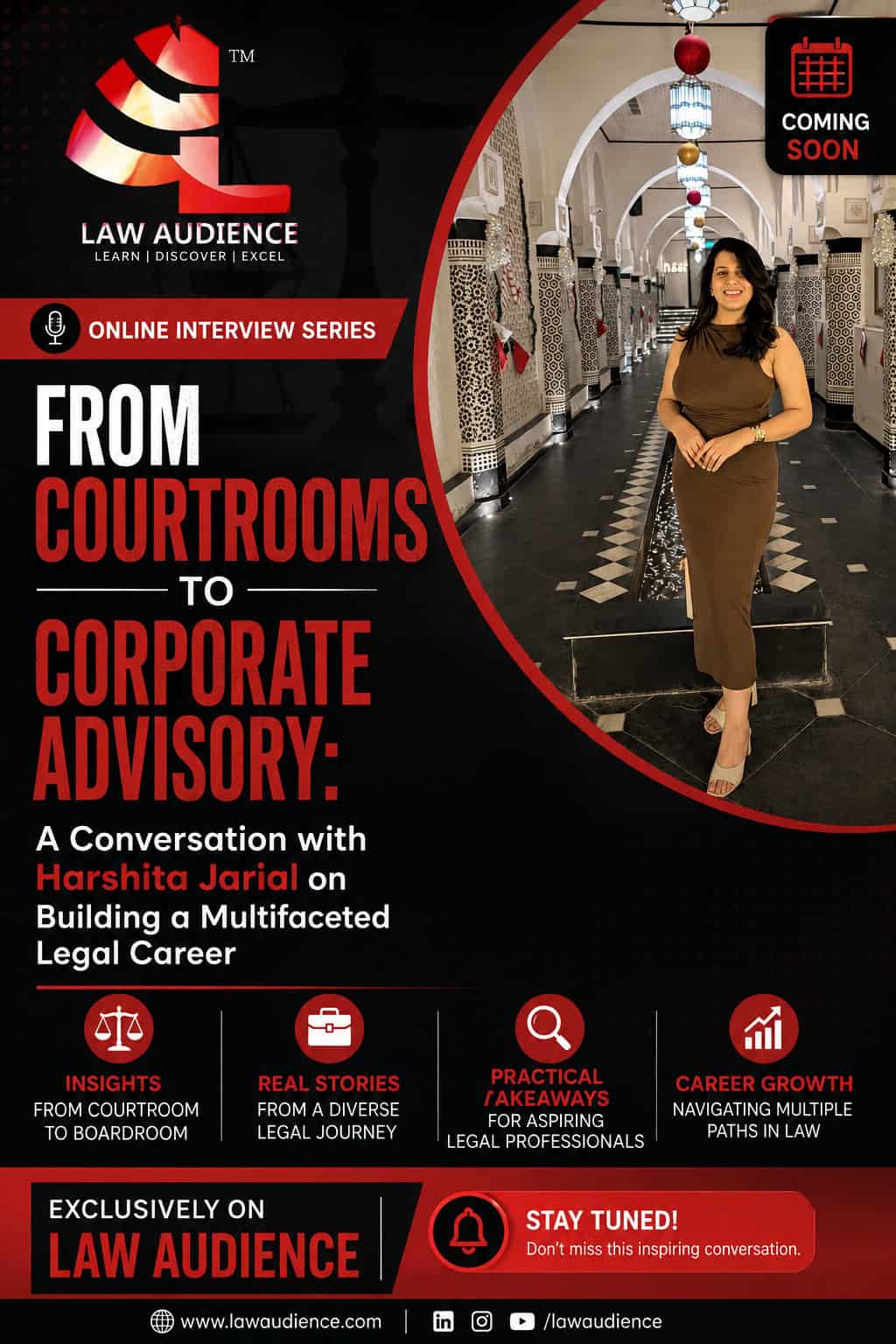
Interview Questions:
Q1. What inspired you to pursue a career in law?
I was drawn to law because it brings together logic, analysis, communication and real-world impact. I enjoyed understanding different perspectives and building an argument, and law offered a profession where those skills could be put to practical use.
Even during law school, I was actively involved in debates, declamations and moot courts, which strengthened my interest in advocacy and helped me become more confident in articulating and defending a position.
What appealed to me most was also the fact that law is a profession where learning never really stops. That combination of intellectual curiosity, communication and continuous learning continues to shape my career today.
Q2. Looking back at your law school journey, what experiences had the greatest impact on your professional development?
Law school gave me both a strong academic foundation and opportunities to develop practical skills. My involvement in debates, declamations and moot courts taught me how to research deeply, structure an argument, think on my feet and communicate effectively.
My internships were equally formative. I had the opportunity to intern with the National Human Rights Commission, the Punjab & Haryana High Court and the Supreme Court of India. These experiences exposed me to very different aspects of the legal system and helped me understand that law extends far beyond textbooks.
Together, these experiences gave me the foundation for my early interest in litigation while developing skills that have remained valuable throughout my career in investigations and advisory.
Q3. How did your experiences during law school influence your eventual career choices?
My experiences gave me exposure to both traditional legal practice and the broader ecosystem around law.
The court internships and moot courts developed my interest in advocacy, while my wider exposure made me curious about how legal principles operate within organisations and businesses. That curiosity eventually led me towards investigations, compliance and advisory.
Q4. You began your professional journey as an Advocate before the Punjab and Haryana High Court. What attracted you to litigation?
Litigation appealed to me because it was immediate, challenging and deeply connected to facts. You had to understand the law, analyse the facts, anticipate the other side and respond in real time.
I practised before the Punjab & Haryana High Court for about four months after college. Although it was a short period, it gave me a strong professional foundation and confirmed how much I enjoyed analytical and advocacy-driven work.
Q5. What were some of the most valuable lessons you learned while practicing before the High Court?
The biggest lesson was that preparation creates confidence.
You cannot control every question or development in a courtroom, but you can control how well you know your facts, your law and the possible counterarguments.
I also learnt that knowing what is relevant and communicating it clearly is often more important than simply knowing a lot.
Q6. What skills from litigation continue to help you in your current role?
Analytical thinking, attention to detail and the ability to remain composed under pressure.
Investigations often involve large volumes of information and competing narratives. Litigation taught me to question the first version of a story, examine the evidence and think critically about how a conclusion could be challenged.
Q7. Did you always envision a career in corporate advisory, or did your interests evolve?
My interests evolved naturally.
I became increasingly curious about what happens before a matter reaches a courtroom how organisations identify risks, investigate misconduct and respond to regulatory challenges.
That led me to EY and eventually into investigations, compliance and forensic advisory. I don’t see it as moving away from law; rather, it was an expansion of how I could apply my legal training.
Q8. What drew you to EY?
EY gave me an opportunity to combine my legal background with investigative and advisory work.
I joined as an Associate in Fraud Investigation & Dispute Services, working alongside consultants, and progressed to the Consultant level. It was an important transition because I began looking at problems not only from a legal perspective but also through the lens of business risk and decision-making.
Q9. What were your key responsibilities at EY?
My work involved supporting fraud and investigation-related assignments, conducting research and analysis, and developing structured findings from complex information.
It was also where I developed a strong appreciation for evidence-based investigations and the importance of objectivity when dealing with sensitive matters.
Q10. How did working at EY broaden your perspective on legal advisory and risk management?
EY taught me that risks rarely exist in isolation. A compliance issue can have legal, financial, operational and reputational consequences.
Q11. It also taught me to go beyond identifying a problem and ask: What does this mean for the organisation, and what should it do next?
Can you share a memorable learning experience from your time at EY?
Some of my most valuable experiences involved sensitive investigations where facts were unclear and stakeholders had different perspectives.
They reinforced the importance of neutrality. An investigator should not start with a conclusion; you test the facts, challenge assumptions and let the evidence guide you.
That principle has stayed with me throughout my career.
Q12. Tell us about your experience working with Angelique International Limited?
Angelique was an important chapter because it gave me experience from within a business organisation.
I worked as an Assistant Manager in the Business Ethics & Compliance team, where I also managed a team. It gave me first-hand exposure to how compliance frameworks work in practice and how policies need to translate into everyday business processes and decisions.
Q13. What legal and compliance challenges are unique to working within a large business organisation?
One of the biggest challenges is balancing regulatory requirements with commercial realities.
A compliance professional needs to understand what the business is trying to achieve, identify the risks and help find a responsible way forward. Effective compliance should enable better decisions rather than simply create barriers.
Q14. How did this role contribute to your understanding of commercial and business law?
It helped me understand how legal and compliance requirements interact with actual business operations.
I gained exposure to business ethics, third-party relationships, internal controls and compliance processes, and learnt that good compliance is ultimately about people, processes and culture, not just policies.
One of your significant accomplishments at Angelique involved working with the World Bank. Tell us about that experience.
One experience I am particularly proud of was my work on the Integrity Compliance Program with the World Bank.
It involved understanding international integrity and compliance expectations and helping translate them into practical processes within the organisation. It was a valuable experience in understanding how global standards can be implemented effectively within a business.
Q15. What brought you to PwC?
By the time I moved to PwC, I knew investigations and forensic advisory were areas I wanted to pursue more deeply.
PwC gave me the opportunity to work in Forensics, particularly Financial Crime Compliance, and develop expertise across investigative due diligence, AML/KYC, sanctions, reputational risk and complex research.
Q16. As a Senior Associate/Assistant Manager at PwC, what did your work involve?
My work involved complex forensic and financial crime compliance matters, including investigative due diligence and assessments across individuals and entities in different jurisdictions.
I worked on ownership structures, open-source and database research, risk assessments and evidence-based conclusions, while also working closely with teams and stakeholders on client deliverables.
Q17. You have worked with clients across different countries and jurisdictions. How has that shaped your professional perspective?
It has been one of the most valuable aspects of my career.
Working across jurisdictions exposes you to different regulatory environments, business practices and risk profiles. It taught me not to assume that one approach works everywhere you need to understand the local context before drawing conclusions.
It has also made me comfortable working with diverse teams and international clients, and strengthened my ability to look at a problem from multiple cultural and regulatory perspectives.
Q18. You also had the opportunity to work with the Ministry of Finance on India’s FATF mutual evaluation. What did you take away from that experience?
Working on matters connected with the Ministry of Finance and India’s FATF mutual evaluation gave me a much broader perspective on financial crime compliance.
It allowed me to understand AML, counter-terrorist financing, beneficial ownership and related frameworks not just from an organisational perspective, but at a national and international level.
It was a powerful reminder that organisational compliance sits within a much larger global regulatory ecosystem.
Q19. How has your role evolved since PwC, and what does your current role at RSM US LLP involve?
I am currently a Supervisor in Forensics at RSM US LLP.
The role builds on my experience in investigations and financial crime compliance, while giving me greater responsibility for managing work, reviewing outputs, supporting teams and handling complex matters.
I am particularly focused on developing both deeper subject-matter expertise and stronger leadership capabilities.
Q20. What areas of advisory work are you most passionate about today?
I am particularly interested in the intersection of forensics, investigations, financial crime, technology and intelligence.
I enjoy understanding complex fact patterns, tracing information across jurisdictions, connecting seemingly unrelated facts and arriving at conclusions that are evidence-based and defensible.
Q21. What are the most exciting trends you currently see in the legal and regulatory landscape?
I think we are seeing an exciting convergence of law, technology, data and investigations.
AI, advanced analytics and new forensic technologies are transforming how investigators process large volumes of digital information from emails and cloud data to mobile and transactional information. Technology can make investigations faster and help identify patterns, but human judgement remains critical in interpreting context and validating evidence.
Q22. In India, the Digital Personal Data Protection Act, 2023 and DPDP Rules, 2025 are also particularly significant. For investigators, they raise an important question: how do you conduct an effective investigation while ensuring that the collection, processing, preservation and sharing of personal data remain compliant?
I believe the intersection of technology-enabled investigations, privacy, financial crime compliance and regulatory governance will become increasingly important.
Q23. As a woman in the legal and consulting profession, what opportunities and challenges have you encountered?
I have been fortunate to work in organisations where I have had opportunities to learn, take ownership and grow.
At the same time, professional growth requires you to make your aspirations visible. Technical capability is important, but so is speaking up, taking ownership and putting yourself forward.
I have also learnt that leadership doesn’t have to look one particular way. You can be decisive and driven while remaining collaborative and empathetic.
Q24. How can organisations better support women lawyers in achieving leadership positions?
Organisations need to provide women with meaningful access to high-impact assignments and leadership opportunities.
Mentorship, sponsorship, transparent career progression and exposure to decision-making roles can make a significant difference.
I also believe organisations benefit when they recognise different leadership styles rather than expecting everyone to fit the same model.
Q25. What advice would you give to young women considering careers in law and consulting?
Stay curious and don’t be afraid to take the less obvious path.
You don’t need to have your entire career mapped out at the beginning. Develop your expertise, strengthen your communication and business skills, and don’t wait until you feel completely ready before taking on a new challenge.
Often, the opportunities that stretch you the most teach you the most.
Q26. Looking back, what has been the most defining aspect of your professional journey?
It has been the evolution of my understanding of what a legal career can be.
I began in a courtroom, moved into consulting and investigations, worked within a corporate compliance function, returned to professional services and then developed deeper expertise in forensics and financial crime.
Each chapter built skills that became valuable in the next. It taught me that a career doesn’t have to follow a straight line to have a clear direction.
Q27. What has been one professional achievement you are particularly proud of?
Two experiences stand out for me.
One was working on the Integrity Compliance Program with the World Bank at Angelique International, where I had the opportunity to help translate international integrity standards into practical compliance processes.
The other was working on matters connected with the Ministry of Finance and India’s FATF mutual evaluation, which gave me exposure to financial crime compliance at a national and international level.
Both experiences allowed me to contribute to work that extended beyond a single organisation or assignment, and that makes them particularly meaningful to me.
Q28. What has working across different organisations taught you?
Each organisation has given me a different perspective.
EY taught me the investigative and consulting mindset. Angelique gave me an in-house understanding of business compliance. PwC deepened my forensic and financial crime expertise and gave me extensive exposure to international clients and jurisdictions. RSM is now allowing me to build on that foundation while developing as a supervisor and leader.
Together, those experiences have shaped a much broader professional perspective.
Q29. What has been your approach to building resilience and adapting to change?
I have learnt to become comfortable with being uncomfortable.
Every major transition required me to learn something new moving from litigation to investigations, then into an in-house compliance role, back to professional services and eventually into a supervisory position.
Resilience, for me, is about trusting your ability to learn, adapt and figure things out even when the path isn’t familiar.
Q30. What advice would you give to law students who are unsure whether to pursue litigation, in-house roles or consulting?
Experience them wherever possible.
Internships can tell you far more about a career than assumptions can. Think about the kind of problems you enjoy solving.
If you enjoy advocacy and courtroom strategy, litigation may suit you. If you like understanding how organisations operate, consider an in-house role. If you enjoy complex problems, investigations and working across industries, consulting may be a good fit.
There is no universally correct path—the right one is the one that aligns with your strengths and interests.
Q31. How can young lawyers make themselves industry-ready while still in law school?
Don’t limit yourself to legal textbooks.
Understand basic finance and accounting, learn how businesses operate, follow regulatory developments and become comfortable with technology and data.
Most importantly, seek practical exposure. Being able to understand a legal issue and explain its commercial or operational implications is a valuable skill in any corporate environment.
Q32. If you could give one piece of advice to your younger self at the beginning of your legal career, what would it be?
Don’t be afraid to change direction.
Changing paths doesn’t mean you made the wrong decision. The skills you build in one environment can become your advantage in another.
My litigation experience continues to help me in investigations, my legal education supports my compliance work, and every transition has added another layer to my professional perspective.
Q33. One word that describes your legal journey?
Evolution.
Q34. Litigation or corporate advisory?
Corporate advisory—with a litigation-trained mindset.
Q35 A legal skill every law student should master?
Issue spotting.
Before you can solve a legal problem, you need to understand what the real problem is.
Q36. A book that influenced your professional outlook?
Thinking, Fast and Slow by Daniel Kahneman.
It reinforced something particularly relevant to investigations: our judgement can be influenced by assumptions and biases without us realising it. Good investigative work requires questioning assumptions and allowing evidence to guide conclusions.
Q37. One professional achievement you are particularly proud of?
Working on the World Bank Integrity Compliance Program and contributing to matters connected with India’s FATF mutual evaluation.
Both experiences gave me a perspective on compliance that extended beyond an individual organisation to the national and international level.
Q38. Your mantra for success?
Stay curious, keep learning and don’t be afraid to evolve.
Q39. What does success mean to you today, and what are your aspirations for the next phase of your professional journey?
Earlier in my career, success was more closely associated with reaching the next milestone. Today, I see it more holistically.
Success means doing work that challenges me intellectually, creating meaningful value and becoming someone people can rely on for sound judgement, integrity and leadership.
In the next phase, I want to deepen my expertise in forensics, investigations and financial crime, while continuing to grow as a leader. I would like to work on increasingly complex, cross-border matters, learn from diverse industries and jurisdictions, and build teams that do work they can genuinely be proud of.
Ultimately, I want my career to reflect curiosity, credibility and continuous growth.


